
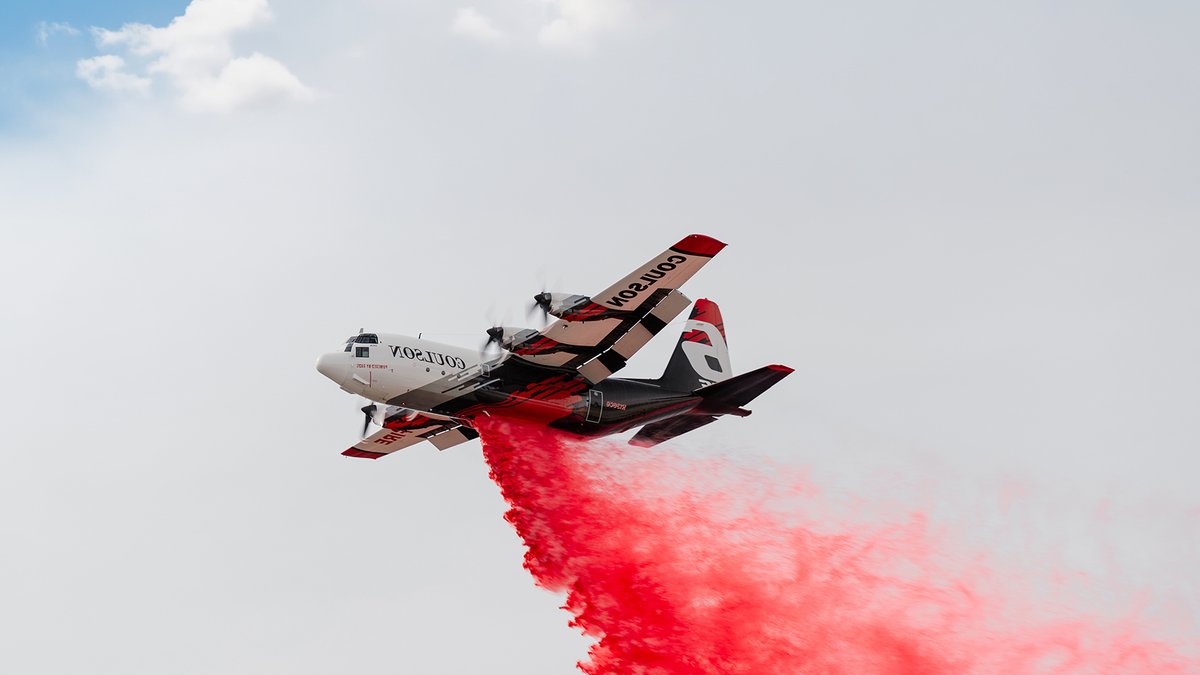
For firefighters battling wildfires, timing remains critical. In recent decades, aerial firefighting planes have expanded in capacity, speed, and operational reach, now operating at night and transporting greater volumes of retardant over longer distances. However, the challenges posed by wildfires have also intensified at a comparable pace.
The industry feels this personally. Longtime professionals have lost friends and colleagues to the risks accepted by firefighters on the ground and crews in the air. Communities remain threatened, and ground crews still need support. The responsibility to be there is absolute, but the gap between technological capability and fire behavior poses a growing danger.
Closing the Aerial Firefighting Gap
EmberWorks was established to close that gap. Coulson Aviation’s technology division combines decades of experience operating large airtankers and heavy-lift helicopters with aerial innovation. By bringing engineering, scientific, and technical capabilities together, EmberWorks creates a direct link between field challenges and development.
Unlike many technology divisions that operate in isolation, EmberWorks develops solutions within an active firefighting organization. This ensures that innovation is guided by practical needs rather than technology for its own sake. When engineers work alongside pilots, firefighters, and maintenance crews, the resulting tools are often sturdier and more reliable than concepts designed by committee. The system must function in turbulence, poor visibility, and chaotic environments where human error is a constant factor. Without this integration, new tools frequently fail in the field because they were never actually tested in the conditions where they are needed most.
Developing Next-Gen Fire Retardant
One of EmberWorks’ current initiatives is CFR HALO. It focuses on improving long-term fire retardant. The system combines advanced chemistry with Coulson’s experience in aerial delivery. The objective is a retardant focused on performance, consistency, and safety throughout the entire delivery process.
The goal is to make aircraft more effective. A better tank system improves drop quality, while a better retardant improves the effect on the ground. These improvements work together to give firefighters a stronger advantage. EmberWorks is evaluating HALO through laboratory and operational field testing. This includes aircraft compatibility, corrosion, toxicity, environmental considerations, storage, mixing, and aerial delivery.
A recent test in May 2026 used a C-130 airtanker at Thermal Airport in California. This allowed researchers to evaluate the retardant within an active delivery system and measure its performance.
Related Post: U.S. expands cyber program with private firms to fight hackers
Turning Aircraft Into Intelligence Platforms
The second initiative, ORBIT, aims to change how information is gathered. The Operational Reconnaissance and Boundary Intelligence Tracker is designed to turn every aircraft into an intelligence platform. Currently, much data depends on what a crew can see or dedicated intelligence aircraft. ORBIT uses fixed electro-optical and infrared sensors to collect information passively during normal flight. The system is being developed to identify heat, map active fire perimeters, locate hotspots, track ember cast, and follow changes in fire activity over time.
An airtanker must remain an airtanker. A helicopter should stay focused on its mission. Crews must not become sensor operators during operations. Sensors collect information in the background. Processing occurs onboard and through connected systems. Useful information can be delivered without adding a complex task to a busy cockpit.
The system will identify heat. It maps active fire perimeters. It locates hotspots and tracks ember cast. It follows changes in fire activity over time. This capability helps answer difficult questions. Researchers can measure what happened after a retardant or water drop. There is a more important possibility. Imagine a ground crew working a division when fire behaviour begins changing beyond their view.
An airtanker passes overhead on its way to a drop. Its ORBIT sensors detect the progression. They update the fire picture. That information reaches firefighters early enough to influence a decision about an escape route. It helps with a safety zone or changing conditions. The aircraft did not have to be dispatched as an intelligence platform. The pilots did not have to operate another piece of equipment. It was already there.
ORBIT evaluates changes in fire activity after aerial drops. Over time, this data helps understand retardant effectiveness. It provides insight into aircraft delivery and fire response. These lessons influence future suppression products and delivery systems. Engineers apply this thinking to personnel awareness. They work on fire modelling and advanced sensing. There is potential in artificial intelligence and autonomous sensing.
Leading the Way With Stu Sprung
Stu Sprung spent nearly a decade in senior aviation leadership with CAL FIRE. He led flight operations for the world’s largest civil aerial firefighting fleet. His work included leading the C-130H airtanker programme. He oversaw statewide night helitanker operations. He helped bring the first intelligence aircraft into service. He oversaw major aviation programmes, operational policy, training, and safety.
Today, Stu Sprung’s work focuses on developing and bringing new aerial firefighting technologies into operational use. He holds a B.A. in Economics and A.S. degrees in Chemistry and Biology. He is a dual-rated FAA Airline Transport Pilot. He has experience across more than 60 aircraft models. He is also a California State Fire Marshal-certified Fire Officer and Instructor.


